

Sonochemistry Letters
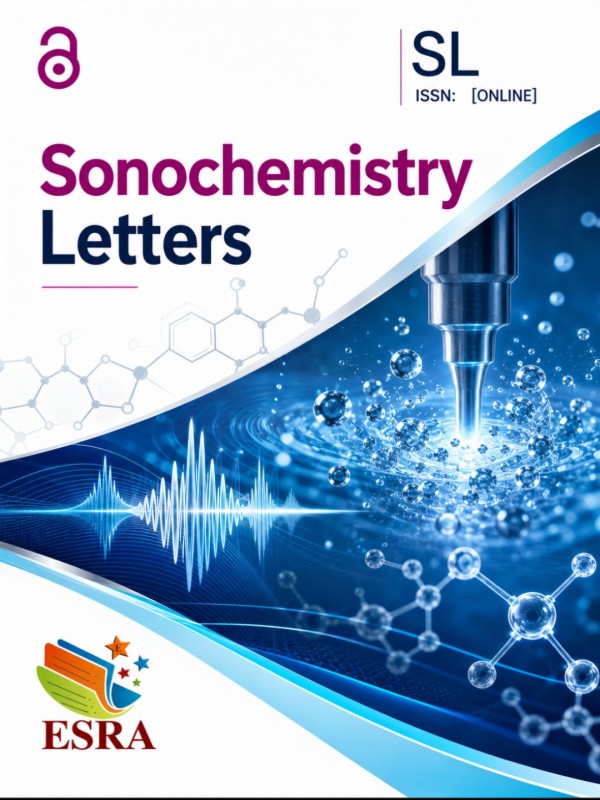
DOI :
language http://www.esrapublications.com/View-Journal.php?id=10&title=sl
Sonochemistry Letters [SL] is an International peer-reviewed, Open-Access Journal dedicated
Sonochemistry Letters (SL) is an international, peer-reviewed, open-access journal dedicated to the dissemination of scientific research and scholarly developments in sonochemistry and ultrasound-assisted chemical processes. The journal is intended for scientists, researchers, academicians, and professionals working on the fundamental and applied aspects of ultrasound-assisted chemical reactions, synthesis, catalysis, and related technologies.
SL provides an international platform for researchers and academicians to present, communicate, share, and advance emerging research, novel methodologies, experimental findings, and contemporary perspectives in sonochemistry. The journal encourages contributions addressing both the fundamental principles and practical applications of ultrasound in chemical transformations and related processes.
Aim
The primary aim of Sonochemistry Letters (SL) is to promote the rapid dissemination of scientifically rigorous research concerning the use of ultrasound in chemical reactions, synthesis, catalysis, mass and heat transfer, and related chemical and technological applications.
The journal seeks to encourage research that improves understanding of acoustic cavitation, sonochemical effects, reaction mechanisms, process intensification, energy efficiency, selectivity, and the application of ultrasound to innovative chemical processes.
Scope
The journal welcomes original contributions in sonochemistry and related areas, including, but not limited to:
- Ultrasound-assisted heating and its theoretical aspects
- Ultrasound-assisted chemical reactions
- Ultrasound-assisted one-pot and multicomponent synthesis
- Influence of ultrasound on mass and heat transfer
- Ultrasound-assisted homogeneous and heterogeneous catalytic reactions
- Ultrasound-assisted solvent-free reactions
- Ultrasound-assisted combinatorial synthesis
- Ultrasound-assisted reactions in conventional and alternative solvents
- Ultrasound-assisted organic and inorganic synthesis
- Sonochemical reaction mechanisms and acoustic cavitation
- Process intensification using ultrasound
- Ultrasound-assisted green and sustainable chemistry
- Sonocatalysis and sonochemical catalysis
- Ultrasound-assisted extraction and separation processes
- Ultrasonic techniques in materials and nanomaterials synthesis
- Environmental and industrial applications of sonochemistry
- Scale-up and technological applications of sonochemical processes
- Other emerging applications of ultrasonic techniques in chemistry and related fields
The journal particularly welcomes interdisciplinary studies connecting sonochemistry with organic chemistry, inorganic chemistry, physical chemistry, catalysis, materials science, green chemistry, chemical engineering, environmental science, and related disciplines.
Types of Contributions
SL considers scientifically sound and relevant submissions including:
- Original Research Articles
- Research Letters
- Brief Communications
- Preliminary Research Reports
- Short Technical Reports
- Novel Methodologies and Experimental Approaches
- Perspectives and Scientific Commentaries
- Review Articles, where appropriate
Manuscripts may present a detailed experimental or theoretical investigation, significant preliminary findings, a novel methodology, an innovative application, or a scientifically relevant new concept in sonochemistry.
Peer Review and Publication
All manuscripts must be prepared in English and are subject to a rigorous international peer-review and editorial evaluation process. Submissions are assessed for scientific quality, originality, methodological soundness, relevance to the journal's scope, clarity of presentation, and compliance with applicable ethical and publication standards.
Accepted manuscripts may be published online within approximately 2–3 weeks following completion of the peer-review and editorial process, subject to satisfactory revision, final editorial approval, and completion of publication formalities.
Manuscript Length and Format
Research contributions generally ranging from 2 to 8 pages may be submitted using the journal's prescribed manuscript format/template. Authors should present their work in a clear and concise scientific format, with appropriate description of the objectives, methodology, results or observations, discussion, conclusions, and supporting references.
Professor M. A. PASHA (Retd.,)
Editor-in-Chief
Department of Chemistry
Bangalore University
Bengaluru, INDIA
E-mail: chief.editoresra@gmail.com
Professor György Keglevich
Professor of Chemistry, Head of Dept
Dept of Organic Chemistry and Technology
Budapest University of Technology and Economics
1521 Budapest PO Box 91, HUNGARY
Email: gkeglevich@mail.bme.hu
Dr. Brajesh Kumar, Ph. D.
Prometeo Researcher II
Centro de Nanociencia y Nanotecnologia
Departamento de Ciencias de la Vida
Universidad de lasFuerzas Armadas ESPE
Av. Gral. Rumiñahui s/n, Sangolqui
P.O. BOX 171-5-231B, Ecuador
LATIN AMERICA
Email: krmbraj@gmail.com; bkumar@espe.edu.ec
Dr. Mohammad Reza Poor Heravi
Department of Chemistry,
Payame Noor University (PNU),
P.O.Box.97, IRAN
E-mail: heravimr@yahoo.com
Dr. S. V. Ranga Nayakulu
Professor of Physcis
Dean (Research & Development)
Guru Nanak Institutions–Technical Campus (GNITC);
Ibrahimpatnam-501506; R. R. Dt.,
T.S., INDIA
E-mail: nayakulu@rediffmail.com; svrnayakulu@gmail.com
Dr. Soheila Gandomi-Ravandi
Laboratory of Organic Compound Research,
College of Chemistry,
University of Kashan,
Km. 6 Qotb-e-Ravandi Bld.,
Kashan, P. O. Box 87317-51167, IR.
IRAN
E-mail: gandomi_so@yahoo.com
Dr. Tamer Said Sayed Mohamed Saleh
Associate Professor,
Chemistry Department,
Faculty of Science, University of Jeddah
JEDDAH, S. A
E-mail: tamsaid@yahoo.com
Note: 1. Editor/s-in-Chief, Associate Editors, Assistant Editors, Editorial board members, Reviewers and other Members do not receive any honorarium or remuneration. These are nominated positions and are voluntarily accepted by the individual academicians.
2. If a Researcher/Scientist/Academician working in this field is voluntarily agreeing to be an Editor or a member of the Editorial Board, kindly submit your Resume/CV to chief.editoresra@gmail.com [mention the email subject: Interested to serve as an Editor/Editorial Board Member].
Use Microsoft Word Software and Times New Roman Letters for preparing the manuscript with double spacing (Use 14 Font size letters for the Title and 12 Font size letters for the rest of the manuscript).
The authors should ensure that, the manuscript has been 'spell checked' and 'grammar checked' before submission.
In order to verify originality of the work presented in the manuscript, your article may be checked by the originality detection service providers such as CrossCheck services.
Authors can use this check list to prepare their manuscripts before submission to the Journal for the Review process.
Title of the Article: Title should be concise and meaningful.
Complete Name/s of the Author/s:
One author should be designated as the corresponding author and his/her contact details have to be provided:
E-mail address:
Fax details:
Phone number/s:
Full postal address:
Provide the Address of all the authors, if from different institutions/countries.
Abstract/Graphical Abstract: Brief outlay of the work presented in the manuscript should reflect here.
Key words: (Maximum 6 Key words)
- Introduction
- Results and Discussion
There can be sub-divisions such as 2.1, 2.2 …. 2.1.1, 2.1.2…. under Results and Discussion.
References should be cited using the superscript format (1, 2‒4, 5,6, 7‒11)
The Figures and Schemes should include relevant captions.
The Table/s should include title/s, description, literature citation (if any) and footnote/s.
3. Experimental (for subjects where experiments are involved, including Science and Engineering subjects)
4. Conclusions
5. Acknowledgement/s
6. Financial Assistance: Financial assistance from the funding agencies to be mentioned here; if there is no funding involved, it should be mentioned clearly as ‘this work is not funded by any funding agencies’.
7. Conflict of Interest: Declarations/disclose of the conflict of interest has to be made by the authors.
8. References
Format:
Reference to a Journal publication:
[1]. S. Al-B. Abdullah, S. S. Tamer, M. Z. Ehab. Ultrason. Sonochem., 2013, 20, 1194–1202.
Reference to Article by DOI:
[2]. M. K. Slifka, J. L. Whitton. Clinical implications of dysregulated cytokine production. J. Mol. Med., 2000, doi:10.1007/s001090000086.
Reference to a Book:
[3] J. L. Luche, T. J. Mason. Sonochemistry, experiment to theoretical considerations: Advances in Sonochemistry, ed., JAI Press, London, 1993.
Reference to a chapter in an Edited Book:
[4] B. Brown, M. Aaron. The politics of nature. In: J. Smith (ed) The rise of modern genomics, 3rd Edn. Wiley, New York, 2001, pp 230−257.
Reference to a website:
[5] J. Bean. How the Internet has Changed (and created new) Holiday Rituals. Available at: http://www.techerator.com/2010/11/how -the-internet-has-changed-and-created-newholiday-rituals/, 2010. [Accessed 12 October 2013].
Supplementary Data should be provided along with the manuscript.
Apart from this,
Names of Referees (any FIVE) and their complete contact details who are working in the same/similar field of Research should be provided in a separate file.
Authors should also provide (if any) the copies of the permission obtained for use of copyrighted material from other sources including the Internet.
The authors should assure that, the work described in the article has not been published previously, except in the form of an abstract in a conference/symposium/seminar or as part of the academic thesis and it is not under consideration for publication elsewhere, and that its publication is approved by all the authors and by the responsible authorities where the work was carried out, and that, if accepted, it will not be published elsewhere in the same form in English language or in any other language, including the electronic media.
Note: If you find difficulty in submitting your manuscript through Login, you can directly submit it to submit@esrapublications.com OR chief.editoresra@gmail.com
Open Access Journals published by the ESRA Publications Pvt. Ltd., are accessible for free of cost on the internet. ESRA Publications guarantee that no author, university library or individual reader will ever have to buy a subscription or pay any pay-per-view fee to access the online articles.
Publication Processing Fee
|
Name of the Journal |
Regular PPF (For International Authors) |
Regular PPF (For Indian Authors) |
|
|
Free |
Free |
|
|